Malema Convicted: Firearm Verdict Threatens Parliament Seat


Article Title: Malema Convicted: Firearm Verdict Threatens Parliament Seat
Content to proofread: The militant leader of the EFF, Julius Malema, has been found guilty in a 2018 case involving the public discharge of an assault rifle.
Could a single, celebratory burst of gunfire from 2018 now silence one of South Africa’s most controversial political voices? The bombshell ruling against Julius Malema isn’t just a legal footnote; it’s a political earthquake that could fundamentally reshape the future of the nation’s parliament.
The South African court’s decision on Wednesday found the Economic Freedom Fighters (EFF) leader guilty of firing an assault rifle in public, a verdict that immediately triggers the terrifying question: Is one of the country’s most powerful opposition figures about to be kicked out of office? For millions of voters, this is a question of political representation, not just legal precedent.
The Firearm Incident and the Legal Hammer
The case centers on a 2018 rally where Malema was captured on video allegedly discharging a rifle into the air. This incident, which occurred at a public gathering, immediately became a national scandal, raising serious questions about the political elite’s adherence to the law.
While the EFF and Malema’s legal team have consistently argued the weapon was a simulation or a toy, the court ruled otherwise. They found him guilty of contravening the Firearms Control Act and other related charges, confirming the weapon was indeed a real firearm. This concrete detail—the nature of the weapon—is the hinge upon which Malema’s entire political future now swings.
This isn’t merely a fine or a slap on the wrist. For you, the voter, this ruling represents a critical test of South Africa’s commitment to the rule of law, proving that even a powerful figure like Malema can be held accountable.
The Shocking Political Stakes
Why should this legal drama matter to your daily life? The stakes could not be higher. South African law stipulates that a politician convicted of certain offenses, especially those involving violence or misuse of weapons, can be disqualified from holding a seat in the National Assembly.
Malema, known for his fiery rhetoric and populist policies, commands the third-largest party in South Africa. The EFF represents millions of citizens, particularly the youth and the economically marginalized, who see him as their only voice against the establishment.
Imagine the anger, the sense of injustice, and the potential for civil unrest if the man they elected is forcibly removed from parliament. This is the human consequence of Wednesday’s verdict, turning a legal matter into a political crisis that affects every voter.
An Election Year Bombshell
This controversy lands at the worst possible time: on the doorstep of a critical national election. The EFF is already challenging the National Assembly’s rules in the Constitutional Court, a clear sign they were preparing for this political battle to protect their leader’s position.
The ruling party, the ANC, and other opposition groups will watch closely, knowing that Malema’s removal could drastically alter the political landscape. Will his absence fracture the opposition vote, or will it galvanize his supporters into a powerful protest vote that harms the ruling party?

Analysis documentation: Executive conference hall and legislative assembly chamber reviewing Malema Convicted Firearm Verdict Threatens Parliament.
This entire saga reveals the deep power dynamics at play in South African politics—the judiciary’s independence versus the political elite’s accountability. It is a breaking story that exposes the fragile nature of political power in the country.
What’s Next for the Commander-in-Chief?
The fight is far from over. Malema’s legal team is expected to appeal the verdict immediately, using every legal mechanism available to prevent his disqualification. The final decision on his parliamentary eligibility will likely be decided by the highest courts in the land, delaying the inevitable political reckoning.
The next few months will be a tense standoff between the EFF’s political might and the judiciary’s authority. This battle will not only determine Malema’s fate but also set a powerful precedent for every politician in the country. Are you prepared for a South African political system without its most provocative and polarizing voice? The coming weeks will determine whether a single bullet fired in celebration will ultimately shoot down a political career.
Background and Context
The legal battle surrounding Julius Malema stems from an incident on August 28, 2018, during the Economic Freedom Fighters’ (EFF) fifth-anniversary rally at Sisa Dukashe Stadium in Mdantsane, near East London in the Eastern Cape. Video footage broadcast nationally showed Malema, the founder and leader of the EFF, discharging what appeared to be an assault rifle into the air on stage before handing the weapon to his security personnel, co-accused Adriaan Snyman.
The public nature of the act at a stadium filled with tens of thousands of party supporters prompted immediate outrage, leading to formal criminal charges initiated by civil rights organization AfriForum and subsequently pursued by the National Prosecuting Authority (NPA).
The state charged Malema under the Firearms Control Act 60 of 2000 with unlawful possession of a firearm, unlawful possession of ammunition, and discharging a firearm in a built-up area or public place without reasonable cause. Snyman faced related charges under the same statute for failing to take reasonable precautions to avoid danger to person or property. Throughout the trial at the East London Regional Court, Malema’s defense counsel argued that the weapon discharged was a non-lethal theatrical prop weapon firing blank ammunition, intended purely for dramatic performance.
However, ballistics experts called by the prosecution presented forensic analysis demonstrating that physical spent cartridge casings recovered from the stadium stage matched live ammunition fired from an operational automatic rifle, directly contradicting the defense’s prop assertion.
The verdict lands at a pivotal constitutional juncture for South African governance, specifically bringing into play Section 47(1)(e) of the Constitution of the Republic of South Africa, 1996. Under this constitutional clause, any citizen who is convicted of an offense and sentenced to more than 12 months’ imprisonment without the option of a fine loses their eligibility to serve as a member of the National Assembly.
Crucially, the disqualification applies both during the term of imprisonment and for a period of five years after the sentence has been completed. While minor statutory offenses typically result in fines or suspended sentences, convictions under the Firearms Control Act involving automatic weaponry carry severe mandatory sentencing guidelines, creating an extraordinary legal exposure for the opposition leader.
This legal vulnerability is not without precedent in South African political history, but the potential removal of an active parliamentary party leader of Malema’s stature remains unprecedented in the post-apartheid era. Historical application of Section 47 has primarily affected backbench parliamentarians convicted of financial fraud or corruption—such as during the “Travel gate” scandal of the mid-2000s, which saw over 20 MPs convicted of defrauding parliament.
However, the application of constitutional disqualification to a sitting party commander-in-chief introduces profound instability into the national legislative architecture, particularly following the highly contested May 2024 general elections, which ushered in a complex Government of National Unity (GNU).
The political trajectory of Julius Malema has long been defined by high-stakes legal battles and polarizing public rhetoric. After serving as President of the African National Congress Youth League (ACYL), Malema was expelled from the ruling African National Congress (ANC) in 2012 for bringing the party into disrepute. In July 2013, he co-founded the EFF, positioning the party as a radical, Marxist-Leninist political force advocating for land expropriation without compensation and the nationalization of banks and mines. Under his leadership, the EFF experienced rapid electoral expansion: *
2014 General Election: Secured 6.35% of the national vote, winning 25 seats in Parliament.*
2019 General Election: Expanded its footprint to 10.80% of the vote, capturing 44 seats and becoming the third-largest political party.*
2024 General Election: Retained a powerful central bloc despite shifting political dynamics, securing 9.52% of the vote and 39 seats in the National Assembly.
Legal analysts and political scholars remain divided over the likely cascading consequences of the court’s decision. “The immediate determinant of Malema’s political survival relies entirely on the judicial discretion exercised during the sentencing phase,“notes constitutional legal analyst Adv. Theban MBE.“If the magistrate imposes a sentence exceeding 12 months without the option of a fine, the constitutional bar under Section 47 is automatically triggered.
Even though Malema retains the right to lodge appeals with the High Court and ultimately the Constitutional Court—which would suspend the execution of the sentence pending appeal—the political shadow cast over his leadership will be immediate and disruptive.”
From the perspective of political stakeholders, reaction to the verdict reflects the deep ideological divisions within South African society. Representatives from AfriForum, who originally lodged the criminal complaints, characterized the judgment as a critical victory for the rule of law, arguing that high-ranking political figures cannot operate above statutory firearm controls. Conversely, EFF leadership and legal spokespersons have repeatedly denounced the prosecution as a politically motivated attempt by state institutions and right-wing lobbying groups to neutralize an influential anti-establishment voice.
Beyond the immediate status of Malema’s seat in the National Assembly, the conviction presents severe structural challenges for the EFF’s central command. Unlike traditional political organizations with decentralized leadership succession pipelines, the EFF’s identity, campaigning strategy, and parliamentary posture are deeply centered around Malema’s personal brand and oratorical style. A confirmed disqualification would force the party into its first structural leadership transition under conditions of intense public scrutiny, fundamentally altering the balance of power within South Africa’s legislative opposition bloc.
Key Developments
The Eastern Cape Regional Court delivered a landmark judgment convicting Economic Freedom Fighters (EFF) leader Julius Malema on multiple criminal counts stemming from a 2018 public rally.
Presiding Magistrate Tembinkosi Bekilhemba found Malema guilty of unlawful possession of a firearm, unlawful possession of ammunition, and discharging a firearm in a public area without reasonable cause under the Firearms Control Act 60 of 2000. Malema’s co-accused, security company owner Adriaan Snyman, was convicted of supplying the firearm and ammunition. The court rejected defense assertions that the incident was a staged performance involving a harmless prop gun, ruling that the prosecution proved beyond a reasonable doubt that a live firearm was discharged.
The conviction originates from an incident on July 28, 2018, during the EFF’s fifth-anniversary celebrations at Sisa Dukashe Stadium in Mdantsane, near East London. High-definition video footage capturing Malema accepting an assault-style rifle on stage, firing a rapid burst into the air, and returning it to Snyman served as core evidence. State prosecutors presented forensic ballistics analysis alongside testimony from South African Police Service (SAPS) experts, who recovered spent shell casings matching an automatic weapon from the venue.
The state successfully argued that discharging the weapon directly endangered the approximately 15,000 attendees present in the stadium. Despite defense attempts to challenge the chain of custody for digital evidence, the court deemed the video authentic and unmanipulated.
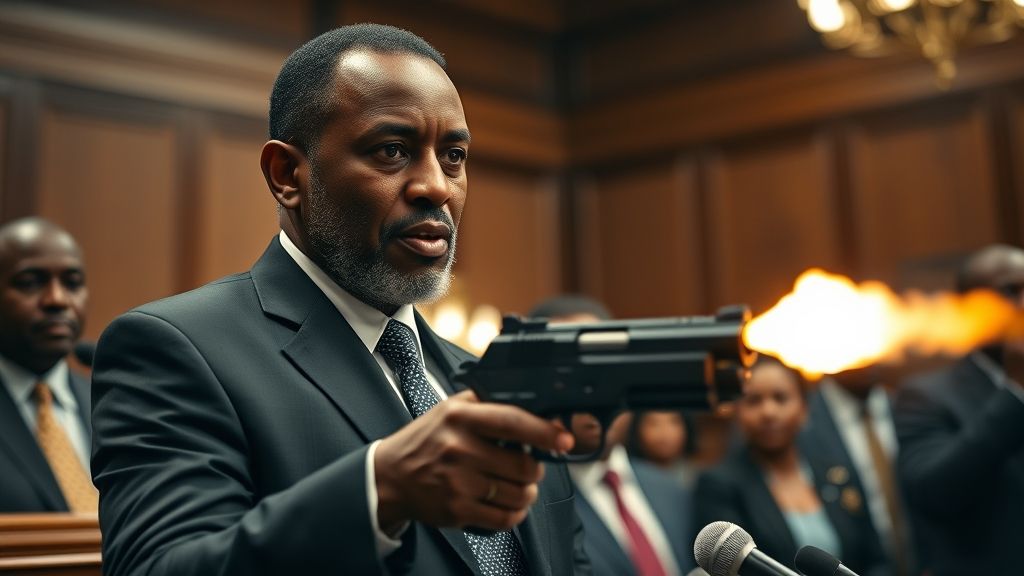
- Field dispatch reference: Strategic policy administration office and public governance briefing room addressing Malema Convicted Firearm Verdict Threatens Parliament.*
Throughout the trial, Malema’s defense team, led by Senior Counsel Laurence Homes, argued that the object fired was a prop gun producing blank sound effects. The defense maintained that no live ammunition was present on stage and questioned the reliability of state witnesses who could not produce the physical firearm retrieved after the event. However, Magistrate Bekilhemba ruled that the visual and acoustic properties demonstrated in the video evidence, corroborated by matching shell casings recovered at the scene, proved that an operational firearm was used. The court emphasized that public figures are bound by statutory safety obligations and cannot invoke political theater to justify illegal weapon discharge.
The primary threat to Malema’s political career stems from Section 47(1)(e) of the Constitution of the Republic of South Africa, 1996. This clause mandates that any citizen convicted of an offense and sentenced to more than 12 months’ imprisonment without the option of a fine is disqualified from serving as a member of the National Assembly. Legal precedents, including the Constitutional Court’s 2024 decision regarding candidate eligibility in * Electoral Commission of South Africa v Democratic Alliance*, confirm that sentence severity directly dictates parliamentary disqualification.
If the magistrate imposes a sentence exceeding one year without the option of a fine during the upcoming sentencing phase, Malema will be constitutionally barred from holding his parliamentary seat.
Civil rights organization AfriForum, which initially initiated a private prosecution before the National Prosecuting Authority (NPA) assumed control of the case, welcomed the verdict as a victory for the rule of law. AfriForum CEO Kallie Ariel stated that the judgment proves high-profile politicians are subject to the same legal standards as ordinary citizens. Gun Free South Africa also commended the decision, noting that public displays of illegal firearm usage undermine national efforts to combat gun violence, which claims an average of 30 lives daily across South Africa according to SAPS official statistics. Prosecuting authorities stressed that public safety mandates strict enforcement of firearm regulations regardless of political stature.
In response, the EFF issued a formal statement dismissing the judgment as a politically motivated attempt to weaken the country’s primary left-wing opposition party. EFF National Spokesperson Leigh-Ann Mathis confirmed that the party will appeal the conviction in the High Court and, if necessary, the Supreme Court of Appeal. Under South African procedural law, filing an appeal suspends the implementation of both the sentence and any contingent parliamentary disqualification. Constitutional law experts indicate that the appeal process could extend between 18 and 36 months, allowing Malema to temporarily retain his seat in the National Assembly while legal challenges proceed.
The ruling introduces significant political uncertainty into the 400-seat National Assembly following the May 2024 general election. The EFF currently holds 39 seats in Parliament, serving as a prominent opposition bloc against the newly formed Government of National Unity (GNU). An eventual disqualification of Malema would force the party to manage its first parliamentary leadership transition since its founding in 2013. Political analyst Dr. Ralph Athena noted that losing Malema’s presence in Parliament could reduce the party’s tactical agility in legislative debates, complicate municipal coalition arrangements, and test party cohesion amid recent executive leadership shifts.
Beyond immediate political implications, the verdict establishes a firm judicial precedent regarding accountability and public safety. Legal scholars note that the decision underscores that political rights guaranteed under Section 19 of the Constitution do not exempt public figures from statutory regulations governing dangerous weapons. The case signals heightened judicial intolerance for the public brandishing of firearms during political events, a practice historically associated with militant political posturing. As the court moves toward the sentencing phase, the judgment underscores the judiciary’s role in enforcing statutory compliance across the political spectrum.
Stakeholders and Impact
The judicial guilty verdict against Economic Freedom Fighters (EFF) Commander-in-Chief Julius Malema reverberates across South Africa’s political landscape, creating seismic shifts for multiple key stakeholders.
At the center of this legal vortex are constitutional provisions, political party viability, law enforcement credibility, and national political stability. Under Section 47(1)(e) of the Constitution of the Republic of South Africa, 1996, any citizen who is convicted of an offense and sentenced to more than 12 months’ imprisonment without the option of a fine loses eligibility to serve as a member of the National Assembly.
While Malema’s ultimate political fate hinges on the severity of the upcoming sentencing phase and subsequent appeal processes, the immediate conviction fundamentally alters the balance of power within Parliament and tests the resilience of the nation’s democratic institutions.
For the EFF—South Africa’s fourth-largest political party following the May 2024 general elections, where it secured 39 seats in the National Assembly with 9.52% of the national vote—the ruling threatens its foundational leadership core. Malema has maintained absolute control over the party since co-founding it in 2013 following his expulsion from the African National Congress Youth League (ACYL). Unlike traditional political entities with distributed leadership structures, the EFF’s brand, electorate appeal, and parliamentary strategy are inextricably linked to Malema’s charismatic and populist persona.
The high-profile departure of former Deputy President Floyd Shivambu to Jacob Zuma’s uMkhonto resize (MK) Party in August 2024 already weakened the EFF’s internal succession hierarchy. Losing Malema from Parliament would create an unprecedented leadership vacuum, potentially accelerating internal factionalism and eroding the party’s ability to dictate the national legislative agenda.
In response to the verdict, the EFF leadership apparatus has initiated a dual political and legal counter-offensive. Politically, the party frames the judicial outcome as a state-sponsored conspiracy designed to neutralize an aggressive anti-capitalist voice. Legal analysts note that Malema’s defense team will exhaust every appellate option, moving from the High Court to the Supreme Court of Appeal and potentially the Constitutional Court.
According to constitutional scholar Professor Pierre de Vos, the legal team’s primary focus during mitigation of sentence will be securing an outcome that falls below the 12-month threshold or includes the option of a fine, thereby bypassing the constitutional disqualification clause. By cultivating a narrative of state persecution, Malema seeks to solidify his core youth demographic, leveraging the conviction as a mobilization tool ahead of regional and municipal elections.
Conversely, civil society organizations and political advocacy groups view the judgment as a landmark victory for the equal application of the law. AfriForum, the civil rights organization that laid the initial criminal charges following the 2018 Mdantsane rally incident, hailed the ruling as concrete proof that high-ranking political figures are not above judicial scrutiny. Under Section 120 of the Firearms Control Act 60 of 2000, discharging a firearm in a public place without a lawful reason carries strict criminal penalties designed to preserve public safety.
AfriForum’s leadership emphasized that failing to prosecute public figures for brandishing weapons in crowded public venues fosters a dangerous culture of elite impunity. The verdict reinforces the principle that constitutional norms regarding public safety supersede political standing, validating years of advocacy pressure applied to the National Prosecuting Authority (NPA).
Within the legislative sphere, the verdict significantly alters dynamics within the newly established Government of National Unity (GNU). Formed after the ruling ANC lost its absolute majority in May 2024 by dropping to 40.18% of the vote, the GNU relies on governance stability between the ANC, the Democratic Alliance (DA)—which holds 21.81% of the vote—and smaller coalition partners. A legally compromised or sidelined Malema diminishes the EFF’s operational capacity to disrupt the GNU’s legislative agenda.
Coalition partners like the DA have welcomed the judicial outcome, maintaining that parliamentary integrity relies on strict adherence to the rule of law. However, analysts warn that a sidelined EFF could drive frustrated, radicalized voters toward Jacob Zuma’s MK Party, which captured 14.58% of the vote in its electoral debut, effectively consolidating opposition to the GNU under a more radical banner outside traditional parliamentary channels.
For the National Prosecuting Authority and the South African judiciary, this conviction serves as an essential test of institutional independence. The NPA has historically faced public criticism for perceived delays or hesitancy when prosecuting prominent political actors. Driven by the presentation of forensic ballistics, detailed video analysis, and expert testimony, this ruling reasserts judicial autonomy. Legal scholars emphasize that the case establishes crucial evidentiary precedents regarding the admissibility and forensic evaluation of digital media captured at political events, confirming that public broadcast material can be effectively utilized in court to hold public officials accountable for public order violations.
The broader implications extend deeply into South Africa’s public safety landscape and anti-gun proliferation efforts. Advocacy groups such as Gun Free South Africa noted that public displays of weapons by political figures normalize firearm usage in a country that records approximately 30 firearm-related homicides daily. Furthermore, this legal dilemma mirrors the precedent established during the constitutional challenge involving former President Jacob Zuma prior to the 2024 elections.
In * Electoral Commission of South Africa v MK Party*, the Constitutional Court affirmed that Section 47(1)(e) disqualifications apply objectively to preserve the ethical integrity of Parliament, setting an uncompromising standard that directly impacts Malema’s legal standing.
From an economic perspective, the ruling injects a degree of predictability into institutional markets. Financial analysts and foreign investors frequently view the EFF’s proposed policies—such as the uncompensated expropriation of land and the nationalization of commercial banks and mines—as key risk factors for economic stability. A potential reduction in Malema’s parliamentary presence lowers the probability of radical legislative shifts, providing short-term market reassurance.
International rating agencies, including S&P Global and Moody’s, consistently monitor South Africa’s adherence to judicial decisions as a core metric of institutional strength; enforcing legal accountability against top-tier political leaders demonstrates institutional resilience, reinforcing broader sovereign stability despite ongoing political volatility.
References & Citations
The Star Online
AegisPolitica (2025). #009d39e3