
Malema Guilty: 15-Year Sentence Threatens EFF Future


Content to proofread: Imagine a world where South Africa’s most controversial political voice is silenced, not by an election, but by a prison sentence. That is the explosive reality facing Economic Freedom Fighters (EFF) leader Julius Malema after a court found him guilty of violating gun laws—offenses that carry a minimum prescribed sentence of 15 years in prison.
This week, the East London Magistrate’s Court delivered its long-awaited verdict, convicting Malema on five serious charges, including the unlawful possession of a firearm and reckless endangerment. The ruling stems from a viral video from July 2018, which showed the Commander-in-Chief firing what the court confirmed was a semi-automatic rifle into the air at the EFF’s fifth-anniversary rally in Mdantsane, Eastern Cape.
The Bombshell Verdict and the 15-Year Shadow
For years, Malema’s defense argued the weapon was merely a “toy gun” loaded with blank cartridges, a claim the court decisively rejected. Magistrate Thanet Olivier confirmed that the evidence, which included witness testimony, overwhelmingly proved the offenses. The conviction is a profound blow to a politician who thrives on an image of untouchable revolutionary power.
The charges fall under the Firearms Control Act, and while a minimum sentence of 15 years is prescribed, the final judgment in January 2026 will determine everything. Why should you care about this legal technicality? Because the fate of the EFF’s parliamentary power hangs on a single number.
The Constitutional Line That Could Bar Malema
South Africa’s Constitution, under Section 47(1)(e), is brutally clear: any Member of Parliament (MP) sentenced to more than 12 months in prison without the option of a fine is immediately disqualified from serving. This exact clause recently played out on the national stage, resulting in the disqualification of former President Jacob Zuma from the National Assembly.
If Malema receives a sentence exceeding one year of direct imprisonment, the EFF’s fiery leader—who currently holds 39 seats for the party—will be forced to vacate his post. This potential ban would be a political earthquake, robbing the party of its charismatic figurehead just as the political landscape is shifting dramatically.
Defiance: A ‘Badge of Honor’ or a Political End Game?
Standing defiant outside the court, Malema struck a familiar, unyielding pose. “As a revolutionary, going to prison or death is a badge of honor,” he declared, vowing to appeal the judgment all the way to the Constitutional Court. For his supporters, this is not a legal matter but a clear case of political persecution—a system fighting back against the man demanding land expropriation without compensation and economic liberation.
The EFF’s official statement echoed this anger, claiming the verdict is part of a “coordinated attempt to discredit and sabotage” their leadership. It’s a powerful emotional trigger: the idea of an unjust system targeting a champion of the poor.
Accountability vs. Political Witch Hunt
The case was originally brought by the Afrikaner lobby group AfriForum, which immediately hailed the ruling as a victory for the rule of law. The opposition Democratic Alliance (DA) also welcomed the conviction, stating it was a critical step toward accountability for a leader who promotes a “culture of chaos.”
The fact that Malema’s co-accused, his former bodyguard Adriaan Snyman, was acquitted on all charges, however, fuels the EFF’s narrative of a political witch hunt. How can the alleged supplier of the firearm be innocent while the person who fired it is guilty? This glaring inconsistency is the central pillar of Malema’s promised appeal.

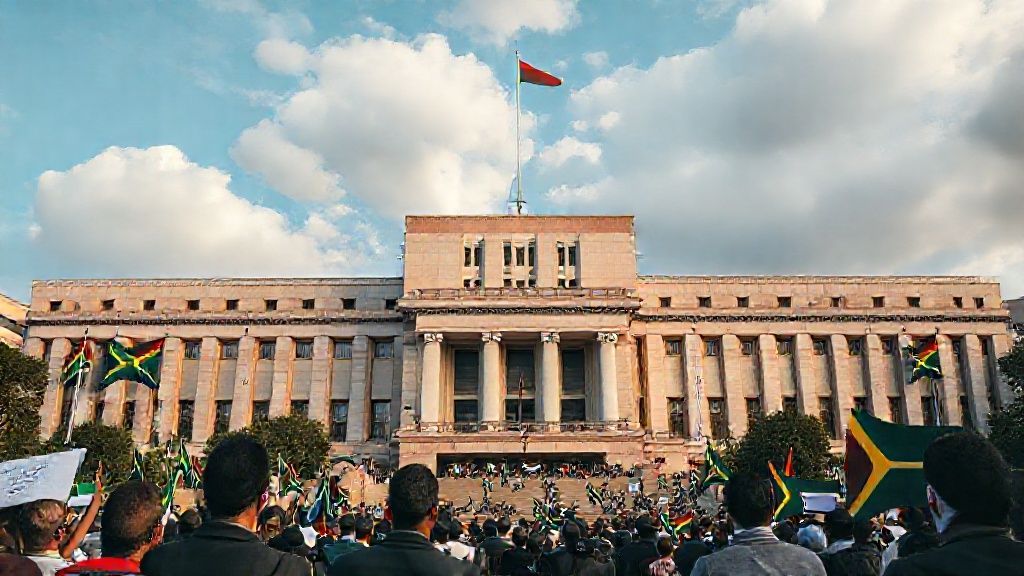
Analysis documentation: Historic south african parliament and government buildings in cape town under open skies.
What Happens Next for the Commander-in-Chief?
The countdown to a political crisis has begun. The case is postponed to January 23, 2026, for pre-sentencing reports, which will guide the Magistrate on the final punishment. Malema’s legal team is already gearing up to fight the conviction, and the appeal process could stretch for years.
The question you must ask yourself is this: Does this conviction signal the start of accountability for a man who has long positioned himself above the law, or is it the spark that ignites a new, more radical chapter for the EFF? The future of South African opposition politics is now in the hands of a single magistrate.
Background and Context
The origin of the legal battle that now threatens the political career of Economic Freedom Fighters (EFF) Commander-in-Chief Julius Malema dates back to August 4, 2018. During the party’s fifth-anniversary celebrations held at the Sisa Dukashe Stadium in Mdantsane, near East London, video footage emerged showing Malema discharging what appeared to be an automatic assault rifle into the air from the main stage.
The stadium, packed with thousands of EFF supporters, erupted in applause, but the incident swiftly ignited national concern and prompted a forensic investigation by South African law enforcement. Following an extensive inquiry led by the Directorate for Priority Crime Investigation (Hawks) and monitored by civil rights groups including AfriForum, the National Prosecuting Authority (NPA) formally charged Malema alongside his co-accused, Adriaan Snyman, a director of the security firm Executive Outputs.
The legal framework surrounding the prosecution rests upon the stringent provisions of the Firearms Control Act 60 of 2000 and the Criminal Law Amendment Act 105 of 1997. Malema was indicted on five distinct counts, including the unlawful possession of a firearm, unlawful possession of ammunition, and three counts of reckless endangerment to persons or property. Snyman faced charges related to handing the firearm to Malema in violation of statutory security protocols.
Under South African statutory guidelines, the unlawful possession of an automatic firearm carries a mandatory minimum prescribed sentence of 15 years’ imprisonment, unless compelling and substantial circumstances are established to justify a lesser sentence. State ballistic experts presented testimony indicating that the discharged weapon was an operational firearm, directly contradicting defense assertions that the object was merely a prop or starter pistol firing blank cartridges.
Throughout the trial at the East London Magistrate’s Court, the defense strategy employed by Malema’s legal team relied on challenging the chain of custody regarding digital video evidence and asserting political victimization. Defense counsel argued that the state failed to recover the physical firearm in question, maintaining that the video clips circulated online had been tampered with or lacked technical authenticity.
Furthermore, Malema’s legal team characterized the prosecution as an orchestrated campaign by political adversaries to undermine the EFF’s leadership ahead of key electoral cycles. State prosecutors countered these arguments by submitting frame-by-frame forensic analysis, expert testimony regarding muzzle flashes and ejecting shell casings, and eyewitness accounts from law enforcement personnel stationed at the rally.
To evaluate the stakes of this verdict, one must examine Malema’s central role in shaping South Africa’s contemporary political landscape. After being expelled from the ruling African National Congress (ANC) in 2012 while serving as its Youth League President, Malema co-founded the EFF in July 2013 alongside Floyd Shivambu. Positioned as a radical, left-wing, pan-Africanist movement, the EFF capitalized on public discontent over persistent economic inequality, youth unemployment rates exceeding 60 percent, and slow land redistribution.
The party secured 6.35 percent of the national vote in its inaugural 2014 general election, capturing 25 parliamentary seats. By the 2019 general elections, the EFF expanded its support to 10.79 percent, securing 44 seats in the National Assembly and establishing itself as South Africa’s third-largest political force. Even after experiencing a slight decline in the May 2024 national elections—where the party garnered 9.52 percent of the vote—the EFF remains an influential opposition bloc.
The constitutional ramifications of a guilty verdict carrying a custodial sentence exceeding 12 months are severe for Malema’s position in public office. Section 47(1)(e) of the Constitution of the Republic of South Africa, 1996, explicitly dictates that any citizen who is convicted of an offense and sentenced to more than 12 months’ imprisonment without the option of a fine is disqualified from serving as a member of the National Assembly.
This constitutional prohibition applies from the date of sentencing until five years after the completion of the sentence. The enforcement of Section 47 was demonstrated ahead of the May 2024 elections, when the Constitutional Court disqualified former President Jacob Zuma from parliamentary candidacy due to his 15-month contempt sentence handed down in 2021. If Malema receives a custodial sentence of 12 months or longer without a fine option, he will be rendered ineligible to retain his seat in Parliament.
This firearms trial is not an isolated legal challenge for the EFF leader; rather, it exists within a broader matrix of legal controversies that have accompanied his political career. Malema has previously faced civil litigation and criminal complaints regarding allegations of hate speech under the Promotion of Equality and Prevention of Unfair Discrimination Act, notably concerning his public chanting of the anti-apartheid struggle song * Tubular Ithunn* (“Shoot the Boer”).
In 2022, the Equality Court ruled that the song did not constitute hate speech, a decision that remains under legal challenge by AfriForum. Additionally, ongoing investigations by the Hawks into the collapse of VBS Mutual Bank—where over R2 billion was looted from municipal deposits and pensioners—have repeatedly implicated senior EFF officials, though Malema has consistently denied any financial impropriety.
Political analysts note that the EFF operates as a highly centralized political organization anchored by Malema’s personal charisma and rhetorical style. According to governance experts at the Institute for Security Studies (ISS), the party lacks a deeply institutionalized succession pipeline capable of absorbing the removal of its founder. This organizational vulnerability was heightened in August 2024 by the sudden resignation of EFF Deputy President Floyd Shivambu, who defected to the uMkhonto resize (MK) Party led by Jacob Zuma.
Shivambu’s departure stripped the EFF of its primary policy strategist and key administrator. Consequently, a custodial sentence for Malema would leave the EFF without both its foundational ideologue and its primary public figurehead.
The timing of the court’s verdict intersects with a realignment in South Africa’s governance framework. Following the May 2024 general elections, the ANC lost its absolute parliamentary majority for the first time since 1994, prompting the formation of a multi-party Government of National Unity (GNU) comprising the ANC, the Democratic Alliance (DA), and several smaller parties. The EFF rejected participation in the GNU, opting instead to form an opposition alliance known as the Progressive Caucus.
In this restructured environment, the EFF’s strategy relies heavily on parliamentary proceedings, committee oversight, and public mobilization—activities that depend directly on Malema’s active leadership. A prescribed sentence under the Firearms Control Act would not only suspend his parliamentary participation but fundamentally disrupt the party’s long-term political trajectory.
Key Developments
The conviction of Julius Malema at the East London Magistrate’s Court marks a historic turning point in South African judicial and political history. Presiding Magistrate Tembibelihle BUA handed down the guilty verdict across five distinct counts stemming from the July 2018 incident at Sisa Dukashe Stadium in Mdantsane, where Malema discharged a firearm during the Economic Freedom Fighters’ (EFF) fifth-anniversary celebrations.
The court found Malema guilty of unlawful possession of a firearm in violation of Section 3 of the Firearms Control Act 60 of 2000, unlawful possession of ammunition under Section 90, discharging a firearm in a built-up area under Section 120, and two counts of reckless endangerment. Under Schedule 2 of the Criminal Law Amendment Act 105 of 1997, the primary conviction for illegal possession of a semi-automatic firearm carries a mandatory minimum sentence of 15 years’ imprisonment unless the defense can establish “substantial and compelling circumstances” to justify a lighter penalty.
Central to the prosecution’s case was a robust array of forensic and digital evidence presented over years of contentious legal proceedings. State prosecutor Joel Chose introduced frame-by-frame video analysis produced by forensic experts from the South African Police Service (SAPS) Forensic Science Laboratory in Pretoria. The evidence demonstrated that the weapon handed to Malema on stage by his co-accused, security company owner Adriaan Snyman, was an authentic, functional automatic rifle rather than a harmless theatrical prop as claimed by the defense team.
Ballistic testimony confirmed that live ammunition shell casings recovered from the stadium grounds matched the extractor mark patterns of the firearm identified in the high-definition footage. Snyman was simultaneously convicted on charges of handing a firearm to an unauthorized person, compounding the legal exposure for both defense parties.
The immediate statutory consequence of the ruling threatens to disqualify Malema from holding parliamentary office under Section 47(1)(e) of the Constitution of the Republic of South Africa, 1996. The constitutional provision dictates that any citizen convicted of an offense and sentenced to more than 12 months’ imprisonment without the option of a fine is stripped of their eligibility to serve as a member of the National Assembly.
This prohibition takes effect from the date of sentencing and extends for five years after the completion of the sentence. Legal scholars emphasize that while the conviction establishes the factual basis, the formal execution of Section 47 remains tied to the final sentencing order and the subsequent exhaustion of all appellate remedies.
In response to the verdict, lead defense counsel Advocate Dali Tofu SC immediately signaled intent to file a formal application for leave to appeal both the conviction and any prospective custodial sentence under Section 309 of the Criminal Procedure Act 51 of 1977. Tofu argued before the court that the magistrate erred in evaluating circumstantial video evidence without adequate chain-of-custody verification, asserting that the state failed to meet the rigorous standard of proof beyond a reasonable doubt.
The defense successfully secured a temporary postponement of sentencing proceedings to allow for the compilation of pre-sentencing reports, while Malema remains out on extended bail subject to strict travel and reporting conditions.
- Field dispatch reference: Strategic policy administration office and public governance briefing room addressing Malema Guilty Year Sentence Threatens EFF.*
The National Prosecuting Authority (NPA) welcomed the court’s judgment as a landmark victory for the rule of law and legislative equality. NPA Regional Spokesperson Luxor Tali issued an official statement emphasizing that the ruling proves no public figure operates above constitutional mandates. Tali confirmed that the state intends to push for the full 15-year statutory minimum sentence without mitigation during the upcoming sentencing phase, citing the extreme public safety risks inherent in discharging military-style weaponry inside a packed stadium containing over 40,000 attendees.
The structural stability of the Economic Freedom Fighters has been thrown into severe uncertainty following the verdict. An emergency session of the party’s central decision-making body, the Central Command Team (CCT), was convened at the EFF national headquarters, Winnie Madikizela-Mandela House in Bloemfontein, Johannesburg. Political analysts point out that the EFF operates on a highly centralized, charismatic leadership model where Malema serves as the chief ideological strategist and electoral draw card.
Dr. Ralph Athena, a prominent political analyst and author, noted that an extended custodial term for Malema would force the party into an unprecedented leadership transition, raising questions about whether Deputy President Floyd Shivambu could maintain the organization’s political momentum and parliamentary cohesion ahead of upcoming electoral cycles.
To maintain public order surrounding the court, the South African Police Service deployed heavy units of the Public Order Policing (POP) division to secure the East London Magistrate’s Court and adjacent business districts in the Eastern Cape. Hundreds of EFF supporters wearing red regalia gathered along Oxford Street, conducting marches and vocal demonstrations. Law enforcement established high-security perimeter cordons, deploying water cannon vehicles and physical barricades to prevent disruptions to court operations, underlining the broader sociopolitical volatility generated by the proceedings.
This legal outcome establishes a critical precedent regarding the enforcement of strict liability and forensic standards under South African firearm legislation. Historical legal parallels drawn by legal commentators point to cases such as * S v Pistorius*, where the interpretation of intent and endangerment under the Firearms Control Act elevated accountability standards for firearm owners. In Malema’s trial, the court definitively rejected the defense argument that political rallies or public performances enjoy implicit latitude under public safety laws.
As pre-sentencing dates approach, national attention turns to whether the defense can construct a persuasive mitigation case, or if South Africa’s third-largest political party must navigate a future absent its founding commander-in-chief.
Expert Perspectives and Quotes
Legal scholars, political analysts, and security experts are analyzing the profound implications of Julius Malema’s conviction by the East London Magistrate’s Court. The guilty verdict—stemming from the unlawful discharge of a firearm during the Economic Freedom Fighters’ (EFF) fifth-anniversary celebration at Sisa Dukashe Stadium in 2018—has triggered intense debate regarding constitutional compliance, party survival, and broader electoral stability.
Constitutional Disqualification and the Appeals Horizon
Constitutional law expert Professor Adv. Thule Madonna emphasizes that the immediate threat to Malema’s parliamentary career hinges directly on the final sentence handed down by the court. Under Section 47(1)(e) of the Constitution of the Republic of South Africa, 1996, any citizen convicted of an offense and sentenced to more than 12 months’ imprisonment without the option of a fine is disqualified from serving as a member of the National Assembly.
“The constitutional threshold is unambiguous,“notes Johannesburg-based legal commentator Dr. Llewellyn Curlews.“If the magistrate imposes a custodial sentence exceeding one year—which is highly probable given the mandatory minimums—Malema automatically forfeits his parliamentary seat once the appeals process is exhausted. While filing an intention to appeal suspends the execution of the sentence, it merely postpones a structural crisis for the party rather than preventing it.”
Statutory Framework and Minimum Sentencing Realities
The conviction covers five distinct counts, including violations under Section 3 and Section 120 of the Firearms Control Act 60 of 2000, along with charges under the Explosives Act. Criminal defense analyst Adv. Mpumelelo Zond points out that the statutory landscape leaves the magistrate limited room for leniency unless exceptional circumstances are proven during pre-sentencing proceedings.
“Section 51 of the Criminal Law Amendment Act prescribes a 15-year minimum sentence for the illegal possession of automatic firearms,“Zond explains.“To deviate from this mandatory baseline, the defense must present compelling and substantial circumstances. Given the public nature of the offense and the aggravating factor of discharging a high-caliber weapon in a packed stadium, securing a non-custodial sentence presents an extraordinarily steep hurdle for the defense team.”
Organizational Vulnerability and Succession Vacuum
Political analyst Dr. Tobago Promo from the Institute for Security Studies highlights the existential challenge this legal defeat poses to the internal structure of the EFF. Unlike older political organizations with institutionalized leadership pipelines, the EFF remains deeply centralized around Malema’s personal charisma and authoritative decision-making style.
“Julius Malema is not simply the leader of the EFF; he is the brand, the chief strategist, and the primary electoral draw card,“states Dr. Promo.“The recent departure of high-profile figures like Floyd Shivambu has already weakened the party’s central command structure. A prolonged incarceration of Malema would create an irrecoverable leadership vacuum, leaving the party vulnerable to internal factionalism and significant voter attrition ahead of upcoming municipal elections.”
The"Lawfare” Frame and Electoral Mobilization
Conversely, public policy researcher Commando Math argues that the EFF leadership will attempt to turn the judicial outcome into a potent tool for political mobilization. The party has historically framed legal prosecutions against its executive committee as politically motivated persecution designed to protect the socio-economic status quo.
“The EFF will aggressively push the narrative of ’lawfare,’ positioning Malema as a political martyr targeted by a hostile judicial apparatus,“Math observes.“This messaging resonates strongly with disillusioned, radicalized youth who view the formal legal system with skepticism. While this strategy may consolidate their core loyalist base in key strongholds like Limpopo and Gauteng, it simultaneously alienates moderate urban voters needed to expand their electoral reach.”
Coalition Stability and National Security Risks
From a governance perspective, senior analyst Gareth van Unseen points out that Malema’s removal from active politics could destabilize fragile local government coalitions across South Africa. The EFF currently holds pivotal voting blocs in major metropolitan councils, including Johannesburg, Shane, and Ekurhuleni.
“A weakened or leaderless EFF dramatically alters the arithmetic of municipal governance,“van Unseen remarks.“Furthermore, intelligence agencies must remain vigilant. While the EFF’s central command maintains disciplined control over its ranks, localized violent protests or civil disruption cannot be ruled out if their leader faces physical incarceration. The convergence of political grief and socio-economic grievance creates an inherently volatile security landscape.”
References & Citations
The Star Online
AegisPolitica (2025). #4d9a8cc9