Malema Guilty: The Reckless Shot That Could Cost His Seat


What if the political firebrand you love or loathe suddenly faced 15 years in prison? That is the seismic question hanging over South Africa today after the leader of the Economic Freedom Fighters (EFF), Julius Malema, was found guilty of five criminal charges, including the unlawful possession and reckless discharge of a firearm in public.
This breaking verdict is more than a legal footnote; it’s a direct threat to the political future of one of the country’s most powerful opposition figures, and it matters to you because the stability of South Africa’s volatile political landscape hinges on it.
The Bombshell Verdict and a 15-Year Shadow
The conviction stems from a 2018 EFF rally in Mdantsane, Eastern Cape, where a video showed Malema firing between 14 and 15 live rounds from what appeared to be a semi-automatic rifle into the air. The court, led by Magistrate Thanet Olivier, dismissed Malema’s defense that the weapon was merely a “toy gun,” concluding that the evidence—including muzzle flash and recoil—was conclusive.
The five counts Malema was convicted on include unlawful possession of a firearm and ammunition, discharging a firearm in a public place, and reckless endangerment. The most serious charge alone carries a maximum sentence of 15 years. The human consequence of this reckless act cannot be overstated: he fired a weapon in close proximity to an estimated 20,000 party supporters. What kind of political leader endangers the very people he claims to fight for?
A Pattern of Incitement Revealed
This firearm conviction is the second major legal blow Malema has suffered in less than two months. Just weeks ago, in August 2025, the Equality Court found him guilty of hate speech. That case centered on his inflammatory 2022 remarks that “you must never be scared to kill. A revolution demands that at some point there must be killing…“For his detractors, including the Afrikaner lobby group AfriForum, who brought the firearm case, these two convictions confirm a dangerous pattern of incitement and disregard for the rule of law. The Democratic Alliance (DA) has already argued that the verdict exposes the EFF’s"culture of chaos, violence, and criminality.”
The Ultimate Political Stake
Malema and the EFF have defiantly rejected the judgment, with the leader claiming the verdict is a “badge of honor” and a clear attempt to silence a revolutionary voice. They maintain this is a politically motivated witch-hunt to derail their agenda of seizing white-owned land and transferring wealth to the black majority—a platform that resonates deeply with millions of South Africans still grappling with post-apartheid inequality.
The real-world political stakes are enormous. Sentencing is scheduled for January 23, 2026. Under South African law, a custodial sentence exceeding 12 months without the option of a fine would constitutionally disqualify Malema from serving as a Member of Parliament.
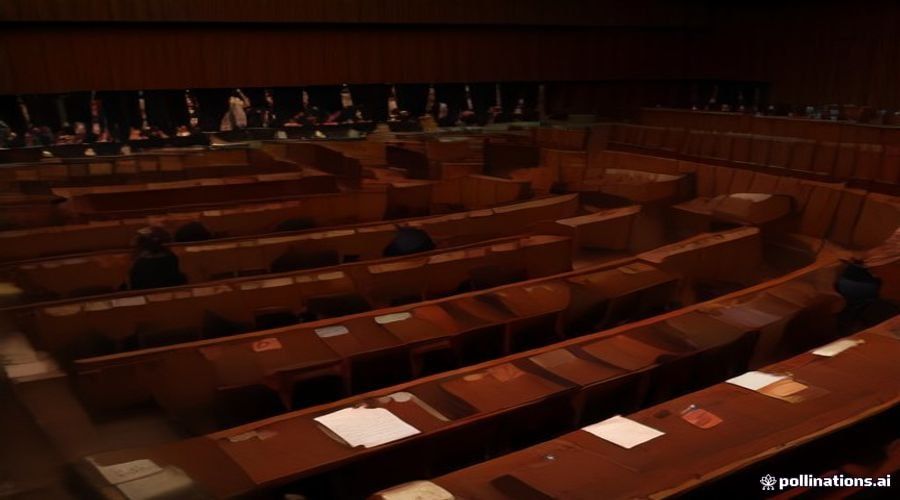
Analysis documentation: Executive conference hall and legislative assembly chamber reviewing Malema Guilty The Reckless Shot That.
If Malema is jailed, the EFF, South Africa’s third-largest party, would be plunged into an unprecedented leadership crisis, potentially fracturing the country’s opposition bloc. The fear among his supporters is that this is the system’s final move to neutralize the most radical voice demanding economic justice. The anger from his opponents is that anything less than a full prison sentence would prove that political elites are above the law.
The EFF leader has vowed to appeal the decision all the way to the Constitutional Court. But for the first time, the “Commander-in-Chief” is staring down the barrel of a legal reality that could end his parliamentary career.
Will the courts prioritize the rule of law and public safety by imposing a sentence that removes a reckless leader from power? Or will the political pressure of the “revolution” force a lighter hand? The outcome of the January sentencing will determine not just the fate of one man, but the very trajectory of South African democracy.
Background and Context
On August 28, 2018, the Economic Freedom Fighters (EFF) gathered tens of thousands of supporters at the Sisa Dukashe Stadium in Mdantsane, near East London in the Eastern Cape, to celebrate the fifth anniversary of the party’s founding. During the rally, video footage captured party leader Julius Malema receiving what appeared to be an automatic assault rifle on stage from his personal bodyguard, Adriaan Snyman.
Malema then pointed the weapon skyward and discharged a rapid burst of gunfire in full view of an estimated crowd of over 30,000 spectators, before returning the firearm to Snyman, who concealed it in a red bag. The video quickly circulated across social media platforms and mainstream media outlets, triggering national outrage and raising severe concerns regarding public safety, the illegal possession of military-grade weaponry, and the adherence of high-ranking political figures to South African law.
Following public complaints and an initial private investigation promoted by civil rights organization AfriForum, the National Prosecuting Authority (NPA) formally charged Malema and Snyman in 2019. The state indicted Malema on five criminal counts: unlawful possession of a firearm, unlawful possession of ammunition, reckless discharge of a firearm in a public place, and two counts of failure to take reasonable precautions to avoid danger to person or property under the Firearms Control Act 60 of 2000.
Snyman faced corresponding charges related to supplying the firearm and ammunition, as well as failing to properly secure a weapon under his control. State prosecutors anchored their case on high-definition video footage, ballistic expert testimony, and mobile network tower data establishing the presence and actions of both accused on the stage at Sisa Dukashe Stadium.
Throughout the trial in the East London Magistrate’s Court, Malema’s legal defense team—led by prominent advocate Laurence Homes—maintained a strategy of complete denial regarding the lethality of the weapon. The defense argued that the object discharged was not a real firearm capable of firing live ammunition, but rather a harmless stage prop utilizing blank cartridges for dramatic effect. Furthermore, the defense routinely contested the chain of custody and digital authenticity of the video evidence, applying under Section 174 of the Criminal Procedure Act 51 of 1977 for an early discharge on the grounds of insufficient state evidence.
However, expert ballistic witnesses called by the prosecution testified that the ejection mechanics, visible muzzle flash, and auditory frequency recorded in the footage were entirely consistent with an operational automatic rifle, effectively dismantling the prop argument.
The constitutional implications of a criminal conviction against Malema are severe and direct. Under Section 47(1)(e) of the Constitution of the Republic of South Africa, 1996, any citizen who is convicted of an offense and sentenced to more than 12 months’ imprisonment without the option of a fine is automatically disqualified from serving as a member of the National Assembly.
This constitutional prohibition applies throughout the duration of the sentence and extends for an additional five years after the sentence has been completed. Should the presiding magistrate hand down a direct custodial sentence exceeding one year, Malema would face immediate removal from his seat in Parliament and an enforced political hiatus from holding public office, stripping him of his primary legislative platform.
To contextualize the political significance of this verdict, one must examine Malema’s decade-long trajectory in post-apartheid governance. After his expulsion from the ruling African National Congress Youth League (ACYL) in 2012 for bringing the party into disrepute, Malema co-founded the EFF in July 2013 as a radical, Marxist-Leninist political movement advocating for compulsory land expropriation without compensation and the nationalization of key economic sectors.
The EFF debuted in the 2014 general elections by securing 6.35% of the national vote, translating to 25 seats in Parliament. By the 2019 general elections, the party expanded its footprint to 10.79% of the vote (44 seats), establishing itself as the third-largest political force in South Africa.
Although its national share adjusted down to 9.52% (39 seats) in the May 2024 elections amidst the rise of former President Jacob Zuma’s uMkhonto resize (MK) Party, Malema has remained the central, undisputed decision-maker of the party structure.
Legal scholars and policy analysts stress that this ruling reinforces fundamental principles of judicial independence and the equal application of the law. Constitutional expert Dr. Pierre de Vos of the University of Cape Town noted that judicial proceedings involving high-ranking political leaders serve as a critical test for South Africa’s constitutional democracy, signaling that legislative standing does not insulate individuals from criminal liability.
Analysts at the Institute for Security Studies (ISS) further emphasize that strict enforcement of the Firearms Control Act is vital in a nation grappling with severe violent crime statistics. According to official South African Police Service (SAPS) data, South Africa recorded over 27,000 homicides during the 2022/2023 financial year, with a significant majority committed using firearms. Legal experts contend that discharging an automatic weapon in a densely populated stadium setting poses extreme public hazards, making lenient sentencing difficult to justify under established legal precedents.
The political fallout of a potential incarceration or parliamentary disqualification comes at a delicate juncture for South African politics. Following the May 2024 general election, the ANC lost its absolute parliamentary majority for the first time since 1994, leading to the formation of a coalition-based Government of National Unity (GNU). The removal of Malema from the National Assembly creates a structural leadership challenge within the EFF, a party heavily centralized around his personal authority as “Commander-in-Chief.” Political scientists suggest that an extended absence of Malema from public office could accelerate voter realignment, potentially benefiting rival populist factions like the MK Party, which currently holds 58 seats in Parliament.
While Malema’s legal team is expected to exhaust all appellate avenues through the High Court and the Constitutional Court, the verdict marks the most severe legal threat to his political survival in his two-decade career.
Key Developments
The legal drama surrounding Economic Freedom Fighters (EFF) leader Julius Malema reached a critical juncture following a judgment at the East London Magistrate’s Court. The charges stem from an August 2018 incident during the EFF’s fifth-anniversary celebrations at the Sisa Dukashe Stadium in Mdantsane, where Malema was captured on high-definition video firing an automatic assault rifle into the air from the main stage.
Following years of procedural delays, interlocutory applications, and defense challenges, the court rendered a guilty verdict on five distinct counts, including the unlawful possession of a firearm, unlawful possession of ammunition, and the reckless discharge of a firearm in a built-up area. The State presented testimony from 19 witnesses, supported by forensic ballistics reports and digital video analysis, which systematically dismantled Malema’s primary defense that the weapon was merely a harmless theatrical prop or starter pistol.
Constitutional Section 47 and the Threat to Parliamentary Tenure
The most severe consequence of the guilty verdict rests within the constitutional architecture governing South Africa’s legislative branch. Under Section 47(1)(e) of the Constitution of the Republic of South Africa, 1996, any citizen who is convicted of an offense and sentenced to more than 12 months’ imprisonment without the option of a fine is automatically disqualified from holding membership in the National Assembly. This statutory mechanism operates objectively upon sentencing, leaving no discretionary room for parliamentary intervention once all appeal avenues are exhausted.
- Field dispatch reference: Historic south african parliament and government buildings in cape town under open skies.*
Should the magistrate impose a direct custodial sentence exceeding the one-year threshold—a distinct possibility under the stringent provisions of the Firearms Control Act 60 of 2000—Malema will be legally mandated to forfeit his seat as a Member of Parliament (MP). This would strip him of his official standing as the parliamentary leader of the country’s fourth-largest political party, reshaping the opposition front in the National Assembly.
Precedent, Appeals, and Judicial Jurisprudence
Legal scholars and constitutional analysts draw direct parallels between Malema’s legal exposure and the constitutional precedent established in the 2024 Apex Court rulings regarding candidate eligibility. In matters concerning statutory disqualification under Section 47(1)(e), the Constitutional Court affirmed that conviction parameters apply strictly to uphold the integrity of the legislature, as seen in the exclusion of former President Jacob Zuma from parliamentary candidacy following his 15-month sentence for contempt of court.
Constitutional law experts emphasize that the legal threshold does not offer leniency for political status. If a trial court imposes a sentence of 12 months or longer without the option of a fine, the disqualification takes effect immediately upon the conclusion of unsuccessful appeals. Even a partially suspended direct prison sentence exceeding 12 months can trigger the disqualification clause, depending on judicial interpretation of served terms versus suspended terms. Consequently, Malema’s primary legal strategy relies on delaying execution through a multi-tiered appeal process to the Eastern Cape High Court and ultimately the Supreme Court of Appeal.
Co-Accused and Private Advocacy Prosecution
The trial also directly implicated Adriaan Snyman, the director of a private security firm contracted to provide executive protection to the EFF leadership. Snyman was convicted alongside Malema on charges of handing the fully loaded firearm to the party leader on stage and failing to keep a firearm under proper control. Snyman’s conviction reinforces the court’s factual finding that the operational handoff was deliberate and handled without standard safety protocols, rejecting claims of a spontaneous stage stunt.
The trajectory of the case was heavily influenced by civil society intervention. The initial criminal complaint was lodged at the Cambridge Police Station in East London by the civil rights organization AfriForum. When state prosecutors initially hesitated to proceed, AfriForum’s Private Prosecution Unit threatened to institute private prosecution proceedings against Malema under the Criminal Procedure Act. This pressure forced the National Prosecuting Authority (NPA) to formally enroll the matter, reflecting a growing trend where civil society organizations utilize the legal framework to compel accountability for high-profile political figures.
Electoral Contraction and Shift in Opposition Dynamics
The timing of this judicial development compounds the political exposure of the EFF following the country’s landmark May 2024 general elections. Official data from the Electoral Commission of South Africa (IEC) reveals that the EFF suffered a notable contraction in voter support, securing 9.52% of the national vote (39 seats in the National Assembly), down from 10.79% (44 seats) in 2019. The party was relegated to fourth place nationally after being overtaken by the newly formed uMkhonto resize (MK) Party, led by Jacob Zuma.
Stripping Malema of his parliamentary platform would remove the primary architect of the party’s legislative strategy at a moment when the EFF is attempting to position itself as the dominant left-wing opposition to the Government of National Unity (GNU)—the coalition government led by the African National Congress (ANC) and the Democratic Alliance (DA). Because the EFF maintains an exceptionally centralized organizational structure centered around Malema’s personal brand and command authority, his potential exclusion from parliament threatens to alter the party’s strategic posture and national visibility.
Defense Counter-Strategy and Judicial Integrity Claims
In response to the conviction, Malema and the EFF’s Central Command Team (CCT) initiated a dual-track strategy combining legal appeals with public political mobilization. Malema’s defense counsel signaled plans to challenge the verdict on appeal, alleging that the presiding magistrate misdirected herself regarding the burden of proof concerning weapon functionality and physical chain of custody.
Concurrently, the EFF leadership launched a communications push, framing the judgment as a coordinated attempt by the state apparatus to suppress political dissidents. Addressing supporters outside the court, Malema characterized the ruling as a politically driven effort to silence the party’s anti-capitalist platform. However, legal experts point out that claims of political victimization hold minimal weight in appellate court procedures, where decisions rest squarely on evidentiary records, ballistic assessments, and established criminal law statutes.
Pre-Sentencing Dynamics and Leadership Vulnerability
As the court moves toward pre-sentencing arguments, state prosecutors are expected to push for a stern sentence, emphasizing that the public discharge of an automatic weapon in a crowded stadium poses severe risks to public safety and degrades public trust in statutory firearms regulations. Under South African law, unlawful possession of an automatic firearm carries statutory guidelines that permit maximum sentences of up to 15 years’ imprisonment depending on aggravating circumstances.
If the magistrate hands down a sentence that triggers constitutional disqualification, the EFF will face an unprecedented leadership succession challenge. Unlike traditional political parties with established institutional pipelines, the EFF has not designated an obvious successor capable of replicating Malema’s public influence and electoral appeal. The outcome of the sentencing phase stands not merely as a personal legal reckoning for Malema, but as a pivotal event with the potential to restructure South Africa’s parliamentary opposition landscape.
References & Citations
BBC News
AegisPolitica (2025). #980ee121